Key figures
Chapter 8: A Second Political Exile, 1914-1920
The Salandra Ministry
When Giolitti stepped down in March 1914, he could never have anticipated that Italy was on the brink of changes that would keep him out of power for over six years: the outbreak of World War I at the end of July 1914; the campaign for Italian intervention in the conflict from September 1914 to May 1915; a long and frustrating war that tested Italy to the limit militarily, morally, and economically; and a bitter postwar period that saw the country divided between nationalist extremism and attempts at a Bolshevik-style revolution. Giolitti’s return to office in July 1920, at the end of this tumultuous period, was a remarkable comeback for a man whose political obituary had been written by most observers in May 1915, but it was also the failure of younger liberal leaders, like Vittorio Emanuele Orlando and Francesco Nitti, who moved ahead of Giolitti during the war. For Giolitti to return, the liberal political class had to fail to renew itself. Even then, it was not an easy road back into the center of political life from the damaging defeat of May 1915.
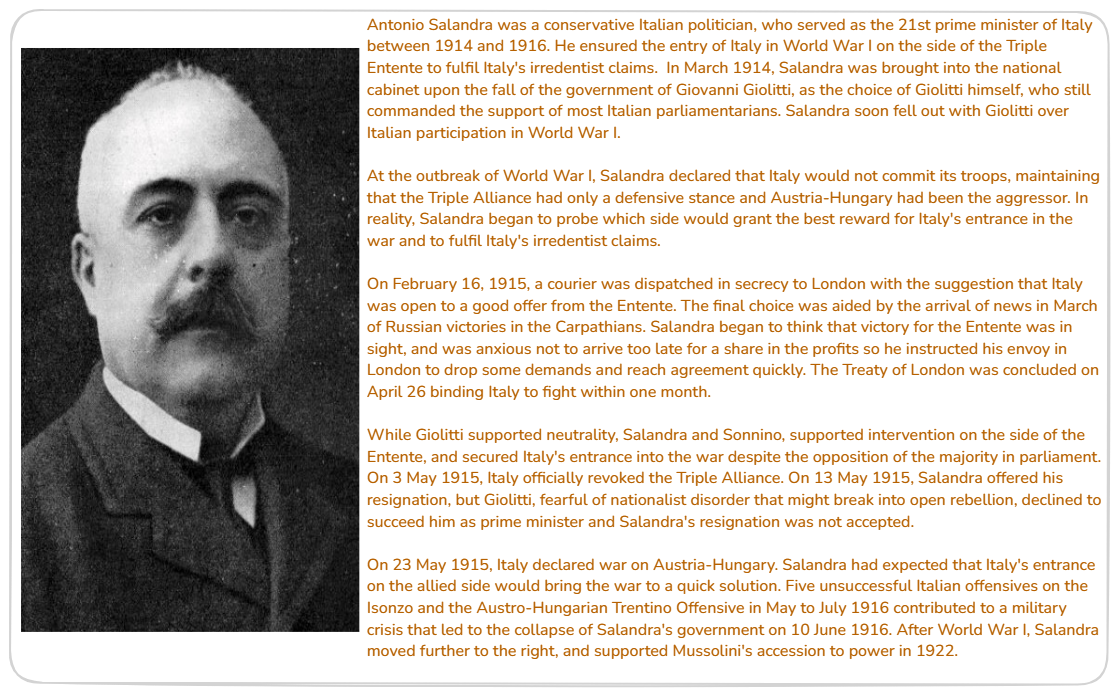
All of this was in the future as Giolitti made yet another periodic withdrawal from the government in March 1914. Antonio Salandra, who knew that he could not form his ministry without the support of Giolitti’s followers, cleverly indicated that he understood how dependent he was on Giolitti’s goodwill. At Salandra’s request, Giolitti intervened to persuade Antonino di San Giuliano to stay on as foreign minister even though San Giuliano considered the new ministry to be “hardly authoritative.” Salandra wanted, but failed, to get another prominent Giolittian in the government.¹ The new president of the Council of Ministers had better luck with the old Zanardellian left, where rancor against Giolitti persisted. Ferdinando Martini, a longtime enemy of Giolitti, signed on, along with ex-Zanardellian Augusto Ciufelli and the former Giolittian Luigi Rava.
Ironically, the Radicals, who had brought down the Giolitti government, were now out of power. The weakness of the new government was apparent in the exceptionally modest program that Salandra outlined to parliament, but his cabinet was confirmed on a 303–122 vote, with the Giolittians voting in favor and the entire Estrema united against.
Giolitti and his allies backed the government throughout the spring and early summer, especially during the Red Week crisis of June 1914, when Salandra banned left-wing newspapers and meetings. Giolitti was adamant that “the fall of the government would be the triumph of anarchy.” He went on to criticize the Socialist Party for putting itself at the service of “the most vulgar hooliganism.”³
Salandra, although held on a short leash, cautiously staked out his opposition to Giolitti for failing to maintain a high level of military preparation.⁴ In July he engineered a first movement of prefects as a step toward undermining Giolitti’s control of the state administration. Ernesto Dallari, who had handled the agrarian unrest in accordance with Giolitti’s more liberal policies, was replaced in Bologna. Other Giolittian prefects also were shifted, but the most significant change was the removal of strong Giolittian prefect Angelo Annaratone from Rome, where his place was taken by Faustino Aphel.⁵ The head of the Roman police was also replaced. These two changes would make a major difference in the crisis of the intervention of May 1915.
The Outbreak of World War I
Salandra would never have been able to attack the basis of Giolitti’s power if the war had not intervened. Inexplicably, Giolitti let himself be shunted aside when he could have retaken the presidency of the Council of Ministers at any point from September 1914 to March 1915. Whether he would have maintained Italian neutrality or eventually joined the war is not at issue. Giolitti refused to assume full responsibility for carrying out policies that he felt were vital for Italy. The best case that can be made is that Giolitti initially was ill, tired, and reluctant to take office so soon. By early 1915 he might have believed that his open neutralism would leave him in a weakened negotiating position and that Salandra might get a better deal from Austria for Italy’s neutrality. Whatever the reasons, ==throughout the 1914–1915 crisis Giolitti’s lieutenants complained that they never understood their leader’s motivations and strategy.==⁶
The war of 1914 certainly spoiled a beautiful summer. No one in Italy expected it. Salandra recalled that he was more preoccupied with the aftermath of the Red Week than he was with the Balkans. Giolitti’s reaction to the outbreak of war echoed that of the rest of the political class. The crisis found him in London and then in Paris, where he told Prince Mario Ruspoli, the first secretary of the embassy, to inform San Giuliano that Italy should not feel bound by the Triple Alliance. San Giuliano agreed on August 3: “Once again you and I have the same reaction without having the opportunity to exchange our views.”⁷
On August 10, Giolitti stopped in Turin, where Alfredo Frassati urged him to return to office: “You never have felt that I pushed you to return to power; but today, yes.” Giolitti offered the lame excuse (as he would do in the summer of 1922) that “in August you cannot provoke crises.” Frassati countered that Giolitti should prepare for November, but the former prime minister seemed decidedly cool to the prospect: “And then on what pretext to bring down the present ministry?” Frassati shot back, “Ah, for this you are the master!”⁸
Salandra tried to offer no pretext for action on Giolitti’s part. After a speech by Giolitti on August 10, in support of the government, Salandra wrote a fulsome letter of praise. But Ferdinando Martini, Salandra’s colonial minister and Giolitti’s bitter adversary, gloated in his diary that the speech had been almost totally ignored and that the Giolittian era was finally over.⁹
Nitti wrote to Giolitti’s son-in-law Mario Chiaraviglio: “If I had foreseen what was going to happen, I would not even have considered leaving the government. Giolitti would have been in this moment a great force for the nation” But two weeks later Nitti wondered what had happened to Giolitti: “The papers assure us that he is still traveling like the wandering Christian.”¹⁰ Giolitti acted as though his influence on the Salandra ministry through San Giuliano would keep it from making any move to intervention: “I do not believe that the ministry has the intention of departing from neutrality, and I have already made known my opinion in the sense that we must not leave neutrality unless new facts imposed themselves as a real necessity for the defense of our vital interests.”¹¹
Giolitti’s confidence in the devious Salandra and his friend San Giuliano was misplaced from the start. In September 1914, Salandra decided to edge Italy toward war. He explained to Olindo Malagodi that the crisis offered a chance to complete the work of the Risorgimento. Already the Triple Alliance was morally dead in his eyes. San Giuliano was more realistic when he told Malagodi “that our sword weighs very little and could not tip the balance” and “that the situation in the war theater is such that our intervention would have neither rapid nor profound repercussions for geographical reasons that everyone can see.”¹² Yet in August, without informing Giolitti, San Giuliano drew up terms to be presented to the Entente powers: annexation of Trento and Trieste, with a border on the Quarnero River in Istria, and of the Dalmatian islands; internationalization of the Albanian port of Valona with Italian administration; and a share in the spoils of Turkey in return for abandonment of the Dodecanese islands.
However, in early September, San Giuliano, in contrast to Salandra, became more cautious.¹³ Salandra, who had promised to telling Giolitti that he was considering war, faced the moral dilemma of Ferdinando Martini: “I am almost obligated to him.” Martini noted the political problem should Giolitti oppose the government.¹⁴ As it turned out, the moment for intervention soon passed. San Giuliano reported to Malagodi that Italy would do nothing: “The war will not end so quickly. . . . We must of necessity wait until spring.” Giolitti, ill with pneumonia, had been admitted to the hospital in Turin and, to Martini’s obvious relief, was out of contact for several weeks. But Salandra, Martini, and even San Giuliano seriously considered double-crossing Giolitti at this early stage, although Salandra was more troubled about it than was Martini, who seemed giddy at the prospect.¹⁵
Pressure for a November Crisis
The Giolittians were increasingly impatient for a return to power. The Salandra government was vulnerable in October after the resignations of War Minister Domenico Grandi and Treasury Minister Giulio Rubini, and the death of San Giuliano on October 16. Grandi’s departure in early October and his replacement by General Vittorio Zupelli had been engineered by anti-Giolittians who were critical of military preparations. The conservative Rubini’s departure was more ominous because he stated that he would rather resign than accept a massive military mobilization. Giolitti’s supporters awaited an indication that their leader was ready to use the crisis to resume power. Instead, Giolitti continued to support the government, even as Sidney Sonnino replaced San Giuliano. The new cabinet now included Sonnino at the Foreign Ministry, Paolo Carcano at Treasury, and Vittorio Emanuele Orlando at Justice. Although the core of the government (Salandra, Sonnino, Martini) was hostile to Giolitti, the entire combination did not appear sufficiently strong or menacing to arouse the Piedmontese leader to action.¹⁶
Giolitti’s suspicions that the prime minister might once again consider intervention were aroused after a speech to the Chamber of Deputies on December 3, in which Salandra spoke of armed neutrality. Privately, Giolitti told Malagodi that Italy simply could not afford a war because it was “an organism still weak, in formation.” Publicly, he reacted by revealing the contents of diplomatic exchanges in 1913 over Austria’s threat to wage a preventive war against Serbia. At that time, Giolitti and San Giuliano told both alliance partners that the casus foederis of the Triple Alliance would not come into effect because Austria’s action was not defensive. In a convoluted way, Giolitti seemed to be arguing that Italy would not be forced to leave the Triple Alliance if it refused to follow Austria into war. He also implied that his government knew how to protect Italian interests. Giolitti’s move caught Salandra, Sonnino, and the king completely by surprise and led to a hasty search of the Foreign Ministry files. Politically, it was interpreted as an effort to destabilize the government. Again nothing came of it.¹⁷
By the end of 1914 Giolitti and Salandra-Sonnino were heading in radically different directions. To some extent, they followed paths first embarked on in the 1880s. ==Giolitti, who had always been impressed by German power, had no doubts about future policy: “The idea that one might make war on Austria without striking Germany is fatuous.” Italy would incur the hostility of Germany which would, even if it lost the war, recover within twenty years to be the major European power. In contrast, Sonnino envisaged a very different Europe. He told Malagodi that a German victory would mean hegemony over the continent for that country, whereas an Entente victory would restore the balance of power. Sonnino considered war a mandate to complete national unity; Giolitti feared the economic and social consequences of war on the fragile state.¹⁸
Otto Joel of the Banca Commerciale attempted to establish a link between Giolitti and the German government. In October, Joel had written to former German chancellor Prince Bernhard von Bülow about the necessity of Austrian concessions to maintain Italian neutrality. The banker indicated that he could serve as a channel to Giolitti.¹⁹ Bülow, newly appointed ambassador to Italy, arrived in Rome on December 17 and met with Salandra to discuss possible Austrian concessions the next day. Two days later Joel offered to put the new ambassador in contact with Giolitti’s adviser Vittorio Rolandi-Ricci, but apart from one chance meeting with Bülow, Giolitti seemed to have wanted only indirect contacts until real concessions could be extracted from Austria. In a letter to Foreign Minister Gottlieb von Jagow at the end of the year, Joel again pressed for immediate concessions. He also quoted a letter from “the man whom I consider the most influential of all” that linked hopes for continued peace in the new year with the satisfaction of Italian aspirations. It is doubtful that Joel would have revealed Giolitti’s thoughts to the German government without permission.²⁰
Joel’s role is evidence that the struggle against Giolitti’s political domination now merged with battles between competing economic and industrial interests. Financial groups hostile to the Banca Commerciale, like Pio and Mario Perrone and Alberto Maria Bombrini of the Ansaldo conglomerate, financed the Idea nazionale, which spearheaded the campaign against alleged German economic domination of Italy. These same groups also backed Mussolini’s Il popolo d’Italia and formed the Banca Italiana di Sconto at the end of 1914 as an “Italian” rival to the Commerciale.²¹
Rumours of War in the New Year
In January 1915 Salandra hinted once again that he was wavering on the issue of war. Talks with Austria in December had gone nowhere despite considerable German pressure on the Austrians, and in January, Count Leopold von Berchtold, the Austrian foreign minister most likely to make concessions, was replaced by the Hungarian Stephan von Burian. In the first days of the new year, Malagodi came away with the clear impression that Italy was only waiting for the right season for a military campaign.²² If Malagodi saw the drift of the government so clearly, why did Giolitti not perceive the danger? Rome was rife with rumors of a potential Giolitti government with the participation of Ettore Sacchi and Salvatore Barzilai, and possibly some Reformist Socialists, but the major figure in the new Reformist Party, Leonida Bissolati, was decidedly hostile to Giolitti and to Bülow’s mission. Nonetheless, Giolitti seemed to encourage allies like Gaspare Colosimo, who was acting as an intermediary with Barzilai. Giolitti would probably have moved against Salandra in mid-January if he could have won from Bülow a clear promise of Austrian concessions in Trento and Trieste, but he had no more luck than the government.²³ Instead, Giolitti returned to Cavour for several weeks. He complained to his daughter Enrichetta of his desire to avoid Rome and “the miserable political gossip that, insofar as it is attached to me, leaves me neither hot nor cold, but sickens and depresses me with the thought that in the political world there are so many small minds and base characters.”²⁴
The Parecchio Letter
Giolitti’s opponents feared that he would manage the ultimate double cross by taking up their positions once he realized that Austria would never negotiate away Trento, Trieste, and Istria.²⁵ But Giolitti remained committed to negotiations with Austria for a variety of reasons, not the least of which was his firm belief that the war would be long and costly, and that Germany would not easily be defeated. However, in the process of clarifying his public position, he made a serious error by allowing a letter on the subject of Austrian concessions, written to Camillo Peano, to be published in La Tribuna. Peano had reported on his frustrating efforts to convince the pro-Entente Reformist Socialists that negotiations with Austria were the best way to guarantee Italian interests. On January 24, Giolitti responded by explaining the circumstances of his meeting with Bülow and denying that he supported neutrality at all costs: “I believe in the present conditions of Europe, much can be gained without war, but information for a complete judgment is lacking for one who is not in the government.”²⁶
Malagodi published Giolitti’s letter on February 1 with a few changes. Instead of molto (much), parecchio (quite a lot) was substituted. The alteration was unfortunate because it gave the impression of a shoddy deal, but the real problem was that by going public in this way, Giolitti made the policy of negotiating with Austria and Germany into a Giolittian alternative and left Salandra little credit if he opted to pursue it. Otto Joel wrote to Bülow that the letter “complicated the parliamentary situation and thus rendered it more dangerous.”²⁷ The letter galvanized both neutralists and interventionists. Luigi Albertini mobilized the Corriere della sera to counteract it. The Nationalists launched a campaign of personal denigration. On the other side, many conservatives, like the clerical Carlo Cornaggia Medici and the vice president of the Banca Commerciale, Luigi Canzi, lined up in favor of negotiations. The Milanese Liberal Association passed a motion favoring negotiations that was signed by an influential group of industrialists and senators.²⁸
The Last Chance to Topple Salandra
In March 1915, Giolitti had his last chance to topple the Salandra government with a coalition that extended from the neutralist right and the Catholics to the Socialists. Nitti put Giolitti’s dilemma in the starkest terms: “However authoritative a politician he may be, outside of government he can do nothing. Peace and war are decided by the responsible government under the auspices and the guidance of the king. In time of war, Parliament does not exist, nor does the opposition.” Thus, Giolitti had to act before the end of the parliamentary session in March. Orlando warned Giolitti that events were moving toward war, and if Giolitti “did not approve, he should refuse confidence, send us home, and take the place himself.”²⁹ Ugo Ojetti and Giuseppe Prezzolini wrote to Gaetano Salvemini that Salandra’s government was over and the Giolittians had their alternative ready. Prezzolini added ominously, “Perhaps energetic action by a small group ready for anything might save us from Giolitti and Bertolini.” Salandra told Andrea Torre that if Parliament insisted on negotiations with Austria, he would have to resign and let Giolitti and Luigi Luzzatti do it.³⁰
On March 8, Salandra met Giolitti at the latter’s residence on Via Cavour to sound out Giolitti’s intentions about a crisis. Giolitti let the moment pass and once again accepted the prime minister’s assurances that the government was negotiating in good faith with Austria. He had to have been the only major politician who still believed that the government was committed to neutrality, but his gullibility might account for his enormous sense of betrayal in May 1915. Those who expected much from Giolitti realized that he had failed them. The end of the parliamentary session on March 22 allowed the government the freedom of action that it sought. When the Parliament met again on May 12, the major decisions had been made. As Nitti, Orlando, and, of course, Giolitti knew, the Libyan precedent made it difficult for parliamentary pressure to be brought to bear on a government. Salandra had to be defeated during the March parliamentary session, before he had made binding commitments. Giolitti later explained that Salandra “did not hide that Sonnino seemed to him favorable to war, but that he [Salandra] would hold him back. It was all a pugliese trick.”³¹ But if Giolitti was fooled, it was because he wanted to be fooled. It remains a sad commentary on his judgment.
Austria’s offer on May 5 fell far short of Italian demands: the Italian areas of the Trentino, Gradisca, some autonomy for Trieste along with an Italian university, and abandonment of Albania to the Italian sphere of influence. By then Italy had joined the Entente. But already in early April, Salandra was committed to war. In Cavour, Giolitti was peppered by letters appealing for conciliation. More ominously, the deputy Alfredo Falciani reported that Salandra continued his purge of prefects in key cities.³²
The May Crisis
Giolitti arrived back in Rome on May 8 for the opening of the parliamentary session. His allies had been thrown into a panic by Gabriele D’Annunzio’s pro-war speech at Quarto on May 5 at a celebration of Garibaldi’s 1860 expedition to Sicily. The government, which had already agreed to go to war alongside England and France under terms of the London Pact of April 26, had hoped that the speech would mobilize the interventionists.³³ Before leaving, Giolitti had been informed indirectly that Italy was committed to the Triple Entente, and on May 5 Bülow sent an intermediary to bring Giolitti up to date on the situation and on the suspicions of the German government that Italy was now obligated to the Entente. Giolitti’s arrival was marked by hostile demonstrations but also by a demonstration of parliamentary support when 300 deputies and senators left their calling cards at his residence. Belatedly, Filippo Turati wrote to Anna Kuliscioff that the Socialists would support Giolitti and might even join his government if the internal party situation improved.³⁴
On May 9, Treasury Minister Carcano was sent to explain to Giolitti what the government had done; Giolitti subsequently insisted that Salandra’s emissary did not tell him the full details of the London agreement. He commented to Pietro Bertolini after the meeting: “I believe that he [Carcano] knows less than the others, notwithstanding that he is a minister.” But Carcano told Edoardo Giovanelli on May 26 that he had informed Giolitti “how things stood and did not keep silent about the irrevocable obligations undertaken by the government of which he was a part.” Thus, whether Giolitti knew the full contents of the London Pact or not, he was informed of the general nature of the Italian obligations.³⁵
Nevertheless, Giolitti continued to act as if there were still room for maneuver. He told Malagodi that Italy was totally unprepared for war. The army was unready, the officer corps was weak because Italians typically sent their stupidest sons to the military, and the cost of the war would fall most heavily on the poorest and weakest economies, of which Italy was one.³⁶ On May 10 Giolitti met with the king, who took Salandra’s position that the pact was binding, not just on the government that signed it but also on the state. Giolitti countered that it was more dishonorable to break the older alliance with Austria. He had been informed through an intermediary of the latest Austrian offers of autonomy for Trieste and obviously judged them good enough to be a basis for negotiation, but the king was unmoved and even spoke of abdication.³⁷
Giolitti then met with Salandra, who worked to convince him that Austria’s offers were less than had been reported. Apparently, Salandra still had not told Giolitti that the Triple Alliance had already been denounced and that military experts were meeting with the Allies, nor did he show him the full contents of the London Pact. This might explain why, when Malagodi passed on this information, Giolitti again denied that anything definitive had taken place: “That, in the end, if the government is compromised, the country is not.”³⁸ Giolitti now argued the absurd position that Salandra could stay in office while denouncing his own London Pact and renegotiating better terms with Austria than Giolitti could have received. Malagodi, who saw Giolitti and Bertolini after the meeting with Salandra, asked Giolitti if he intended to return to power. Giolitti rejected the idea: “I am by now too compromised as [being] against the war and I will not have the necessary leverage to negotiate in depth.” Malagodi asked if he could publish the news that Giolitti would not return, but Bertolini, possibly influenced by reports of last-minute Austrian concessions, interjected that it would be better to keep quiet. Giolitti’s lieutenant, Alfredo Falciani, tried to arrange a meeting of Giolitti, Turati, and Claudio Treves, but old rancors persisted. However, Giolitti could expect backing from the Catholics if he sought to return to power.³⁹
The interventionist press was predictably hysterical. Benito Mussolini’s Popolo d’Italia screamed that “it would be necessary to shoot, I say shoot, in the back a few dozen deputies and to put away for life at least a pair of ex-ministers.” The Giolittian parliament was the “rotten abscess that poisons the blood of the nation.” The Idea nazionale called Giolitti “an enemy of Italy”; his followers, “a criminal band” that should be “eliminated once and for all from the political and moral life of Italy”; and the Austrian concessions, “the price of cowardice.”⁴⁰ Giolitti finally had enough when the Reformist Socialist Party referred to him as “an enemy of the country because I expressed . . . an opinion in conformity with my convictions and in line with opinions already expressed in parliamentary speeches and in the public press. It is inexplicable how parties that profess principles of broad liberties have such slight respect for the opinions of others.”⁴¹
Andrea Torre and Alberto Bergamini believed Giolitti’s forces would overwhelm Salandra: “We are, as you see, before a terrifying domestic crisis. I have reason to believe that the accord between Bülow and Giolitti is more complete and intimate than it seems.” Martini estimated that the government could count on only 120 to 150 votes in the Chamber of Deputies.⁴² The government voted to resign on May 13, and Salandra informed the king. When called by Vittorio Emanuele on May 14 for formal consultations on the crisis, Giolitti, realizing that Italy faced a constitutional crisis, refused to take the presidency; incredibly, he suggested the interventionist Giuseppe Marcora or Carcano. By proposing Marcora, who had no intention of accepting, Giolitti revealed that he lacked a strategy to deal with his opponents. Carcano was the real choice of many Giolittians, but he, too, informed the king that he favored war.⁴³
Pro-war demonstrations gained intensity that the mob could not have been the work of the government: “As you [Turati] already said yesterday, it seems to me that Giolitti’s move, backed by all of you, has served for nothing more than to arouse latent patriotic feelings, and yesterday 100,000 people descended into the piazza.”⁴⁴ A hysterical Mussolini wrote to Giuseppe Prezzolini on May 15: “You ask from me five lines of prose for Giolitti. . . . Right! I’d like to give him five revolver shots in the stomach.” Giolitti was the target of this hate, but the crowds and those who incited the mobs also struck at parliament and the political class. Ivanoe Bonomi crowed that May 14–15 had broken the back of Giolitti's power. The rage against Giolitti that had accumulated for over a decade now exploded against all institutions of representative government. The dissident youth culture of La Voce, fanatic purveyors of hatred like Mussolini and the Nationalists, democrats like Salvemini, and classic liberals like Albertini formed an unwieldy and inherently contradictory alliance for war.⁴⁵
The violence of the crowds shocked Giolitti, who had never allowed similar demonstrations. Decisions over war or peace were properly made in parliament, not on the piazza, but suddenly things had changed. Camillo Garroni wrote from Constantinople: “To allow that our country be at the mercy of the piazza composed of Republicans, Freemasons, revolutionary Socialists, and mercenaries seems to me an enormity.”⁴⁶
The crisis ended almost as quickly as it began. On May 17 the king reconfirmed Salandra; Giolitti left Rome that day. The level of violence had reached a point where his life was in danger.⁴⁷ The Roman daily Il Messaggero commented that Giolitti had been driven out by popular outrage: “He cannot hope for forgiveness and forgetfulness in the patria. He may content himself with the applause of the German press and in the gratitude of the ambassadors of the Kaiser and of Franz Joseph.” But Il Messaggero was cordial in comparison to the Idea nazionale: “Therefore Giolitti, O people of Italy, is a traitor, your betrayer, and as such he may be subjected to the scorn of the vendetta.”⁴⁸
Carlo Schanzer told Giolitti that his followers had no option but to vote for war and support the government. Nitti also made his peace with Salandra once the war was declared. In a letter to Mario Chiaraviglio, he said that he would urge his electors to support the war. Between the lines one can detect a feeling of relief that Giolitti’s career was finally over and the way was now open for new leaders like himself.⁴⁹ The vote for war came on May 20. Of the seventy-four negative votes in the Chamber of Deputies, thirty-seven or thirty-eight were from Socialists; the rest were Catholics and Giolittians. Some, like Edoardo Giovanelli, voted for the war with deep feelings of shame: “Yesterday evening I hadn’t even the courage to write you. I seemed to be tainted by a crime in voting full powers, as did almost all the friends.”⁵⁰ In the Senate Antonio Cefaly simply stayed away. Camillo Peano came closest to assessing the true cost of the crisis: “But it is sad to have brought down parliament in the face of the mob. By eliminating the constitutional function of representative government, the king finds himself directly before the people. Unfortunately, this people that today cries hosanna, tomorrow cries crucifixion. One starts on the road to revolution with such systems.”⁵¹
The failure of 1915 called into question Giolitti’s judgment and even his approach to governing, which was ill suited to moments of mass passion. Universal manhood suffrage, the outbreak of the war, and the new politics of direct action had unleashed forces that Giolitti countered with political weapons forged around the turn of the century. They failed him in 1915, as they would in 1922.
Political Exile
When Giolitti left Rome in May 1915, few doubted that his political career was over. His enemies were firmly in power. He wrote to his son Giuseppe: “I thought it best to come to Cavour because my presence at the session of the Chamber might have been the occasion or pretext for some intemperance not suitable to the solemnity of a session that had to take vital decisions.” Parliament, the base of Giolitti’s support, had been humiliated. The anti-Giolittians viewed the decision for war as a repudiation of old methods and institutions.⁵² At the time of his defeat in late 1893, Giolitti was just over fifty. In 1915 he was almost seventy-three. No possibility existed that he could return during the war, and no one knew how long the conflict would last.
Giolitti’s enemies feared exactly what Senator Cefaly counted on: “Time rewards those who merit it, and Giolitti is for now alive and healthy.” The Idea nazionale warned that “much of Giolitti remains, even if Giolitti has disappeared.”⁵³ Salvemini, always a good hater, passed on to Ferdinando Martini his pessimistic conclusion that Giolitti’s power had not yet been dismantled and complained that Salandra seemed unwilling to break with the old Giolittian framework“ once he began to see that even under him the Giolittians are the masters as before.” In short, what Giolitti understood in March 1914 gradually became apparent to the ardent interventionists. Salandra merely wanted to turn the existing system to his advantage, not create a new one.⁵⁴
Giolitti’s enemies kept up a steady attack on both La Stampa and La Tribuna, which were allegedly conspiring with the Giolittian Banca Commerciale. The Perrone-Ansaldo group, already in control of the Roman Il Messaggero, the Idea nazionale, the Genovese Corriere mercantile and Secolo XIX, as well as the Banca Italiana di Sconto, aspired to reel in the Banca Commerciale as well and dismantle the financial underpinnings of Giolitti’s power. The Perrone-Ansaldo-Banca di Sconto combination found an alternative leader in Francesco Nitti, who obliged by joining the campaign against foreign (German) capital in Italy. La Tribuna would have been vulnerable after a successful takeover of the Banca Commerciale, but the Giolittians feared a direct attack on Frassati’s La Stampa. Speaking for Giolitti, Luigi Facta warned Justice Minister Orlando that the rumor circulating in Turin “that the government wants to suspend, if only temporarily, the publication of La Stampa. Giolitti (who also heard the rumor), . . . felt it useful that I, in his name, warn you of the matter.” Facta noted the impact that such a move would have in Turin and on relations with the Giolittians: “In any case, it is up to you to see how things really stand and, if you want, let me know about it.”⁵⁵
Parliament and the Giolittians
Interventionists viewed the reopening of Parliament as a kind of defeat. Edoardo Giretti complained to Salvemini that he had to return to Rome for a meeting of the Radical Party central committee that had been forced by the party's pro-Giolittian wing: "Wonderful! as if there is a parliament in Italy and the revolution of last May had not trampled on and cast away this caricature of a parliament elected by the prefects and the enforcers of Giovanni Giolitti." Giretti and the right-wing Nationalists were increasingly aware that Salandra was unwilling or unable to use the mandate given in May to carry out a political revolution. Giolitti’s support for Salandra’s government after May 1915 was based on this understanding of his rival’s limitations and his sense that it was not yet time for settling accounts. Giolitti’s intentions were clear to his supporters. Facta wrote to Giolitti on December 2 that the group would not oppose a government already on its last legs.⁵⁶
Criticism of Salandra from his interventionist allies sharpened in February and March 1916 after Italian reverses in Albania. Salandra disappointed expectations in the interventionist camp by keeping the basis of his government almost exclusively within the liberal bloc. The interventionists appointed a committee, headed by Bissolati, to present their complaints to the government. In March 1916, Albertini argued in vain that to break with Salandra would only favor the Giolittians.⁵⁷ A successful Austrian offensive in the Trentino was the final blow to Salandra, whose government collapsed in June 1916. On the motion of confidence, fifty Giolittians joined a heterogeneous coalition of the antiwar Italian Socialist Party, the pro-war Reformist Socialist Party, Republicans, Radicals, Constitutional Democrats, and Nationalists to defeat Salandra, even though Giolitti had urged Giovanelli and Facta to keep the group in line behind the government.⁵⁸
Boselli and the return of the Giolittians
The new cabinet, headed by the ineffectual seventy-eight-year-old Paolo Boselli, was a coalition of its strongest personalities: Sonnino, Orlando, and Bissolati. Sonnino kept the foreign ministry; Orlando shifted from Justice to Interior; and Bissolati held no portfolio but represented the democratic interventionist movement. From Giolitti’s perspective the government was a clear advance. Boselli indirectly consulted with Giolitti on the appointment of Gaspare Colosimo at the Colonial Ministry. Orlando showed himself particularly solicitous of the Giolittians in parliament by appointing Giolitti loyalists Giacomo Vigliani to be director of Public Security and Camillo Corradini as undersecretary at the Interior Ministry, thereby throwing the interventionists into a frenzy.⁵⁹
Giolitti’s pessimism about the war did not lessen with the change of government. A recurring note of impatience with the give-and-take of political life appeared in his wartime letters. He complained of “parliamentary intrigues.” Those who thought that they could dominate events were “candidates for the asylum.”⁶⁰ Giolitti seemed reluctant to return to the parliamentary battles in the existing climate of hostility. He even rejected a request from Marcello Soleri for local appearances: “I did not want my appearances among such sincere and faithful friends to give rise to demonstrations and speeches that might have been wrongly interpreted.”⁶¹
Giolitti’s associates recognized their leader’s desire to remain above the fray. At the end of 1916 the Giolittians approached the Socialists for an agreement to pressure the government on peace negotiations. When Guglielmo Gambarotta followed up by offering a motion in the Chamber of Deputies on December 18, 1916, that called on the government to respond to the overtures of the Central Powers, he told Giolitti that he deliberately kept his leader out of the decision, but he felt that it reflected Giolitti's thinking.
Giolitti and Nitti
There is no way of knowing if Giolitti would have eventually opted for war in 1915 or 1916 had he replaced Salandra. His public and private comments remained consistently critical of the decision to intervene in the conflict. Thus, it came as a surprise when Nitti publicly stated that if Giolitti had been in power, Italy would have gone to war anyway. Giolitti immediately complained to their friend Senator Tommaso Senise: “Perhaps he did not realize that his statement was the most serious injury that one can inflict on a politician, judging him capable of counseling a policy different from that which he would have followed if he had been in the government.”⁶³ When Giolitti wrote to Nitti directly to this effect, Nitti responded lamely that he personally never believed it possible for Italy to remain neutral, and he assumed that most leading politicians, including Giolitti, felt the same way. The exchange allowed Giolitti to voice his fears about the postwar period: “Certainly the social transformation will be more profound than any other recorded event in history, and the bourgeoisie above all will pay the price.” But he retreated not an inch from his contention that he would not have entered the war.⁶⁴
Giolitti and the Growing Disillusionment with the War
Giolitti became, quite unwillingly, associated with the mood of war weariness that gripped Italy. The secret session of the Chamber of Deputies in June 1917 to discuss war policy degenerated into open fighting between Giolittians and interventionists. Turati wanted Giolitti to come to Rome to take up the challenge: “It is not right for an influential politician in such a serious moment to remain hidden and let others do the work. One might understand the absence under Salandra, but with Boselli and Orlando he doesn’t even have to fear for his skin.”⁶⁵ But Turati was to be disappointed. Giolitti remained in Cavour, far from the Chamber.
During the secret session of the chamber, Alfredo Falcioni accused the interventionists of inciting Giolitti’s assassination in May 1915. The Rome correspondent for La Stampa described the scene to Frassati:
“On you,” exclaimed Hon. Falconi, turning to the interventionists of the Estrema, “[lies] the responsibility if Hon. Giolitti had to withdraw for two years in silence. You wanted him dead.” At this point from the benches of the interventionists the name [Public Security Director Giacomo] Vigliani was shouted. Then Falconi, unfazed, cried: “It is really due to comm. Vigliani if Giolitti was able to save his life. If the director of Public Security had not insisted on obtaining two divisions of cavalry to defend Giolitti’s residence that you had besieged, Hon. Giolitti would have been a victim of your violence. Shame on you for what you have done.”
Antonio De Viti De Marco and other interventionists then charged the benches of the Giolittians. At that point Colonial Minister Colosimo shouted from the government benches: “Giolittismo has always been the highest expression of patriotism.”⁶⁶
Giolitti was well aware that the extreme interventionists were urging a military dictatorship under army commander in chief General Luigi Cadorna. Anna Kuliscioff noted that the move to rehabilitate the former prime minister provoked the interventionists to call for a war cabinet. Giolitti made a clear reference to the calls for dictatorship in a letter to Schanzer: “A ministry that adds a civil war to the war against the enemy will bring the country to complete ruin.”⁶⁷
In August 1917, Pope Benedict XV issued his note to the contending powers that called the war “a useless slaughter.” Giolitti’s annual speech to the provincial council of Cuneo picked up the same theme, although without the inflammatory phrase, by referring to the cost in blood and money that was far “more than anyone had predicted.” Postwar problems would be economic and social:
It is inevitable that at the end of the war, the public mood, especially among the popular classes, will be profoundly altered. How many millions of workers of the cities and fields . . . will return to their humble houses, will return with the consciousness of their rights and demand a new order marked by greater social justice that a grateful Fatherland will not be able to deny them.⁶⁸
Bread riots in Turin in August, which left 41 dead and 152 wounded, intensified the attacks on the government, especially on Orlando’s handling of public order. Mussolini lamented that the heroic minority who forced the mass of Italians to war had been betrayed by subsequent leadership: “We have entrusted the war to men who do not feel it as we do. These men have immediately vaunted their detachment from the interventionist piazza that really brought them to power.”⁶⁹ In September, interventionist pressure forced Orlando to dump both Corradini and Vigliani, but without resolving the crisis that gripped the Boselli government. Orlando, backed by the Catholic Filippo Meda and the Giolittian Colosimo, emerged as the candidate of the ex-neutralists and moderates in the parliament organized into the Parliamentary Union to formalize their position that the next government should be more responsive to the Chamber. The interventionists soon countered with their own umbrella parliamentary group, the Fascio Parlamentare di Difesa Nazionale, to press Orlando for tougher action against the Giolittians and Socialists. Membership in the new group reached 158 deputies and 92 senators, but it received little encouragement from the government.⁷⁰
Orlando formed his ministry just as the Austrians broke through the Italian lines at Caporetto on October 24, and what might have been a reversal of wartime political alliances rapidly became a government of national emergency. Giolitti sent Orlando a telegram of support as soon as the ministry was formed, and although it was hard to accept a government with both Bissolati and Sonnino, almost all giolittiani voted in favor of the new ministry.⁷¹
Caporetto and the Orlando Government
Caporetto was a devastating psychological blow to those who fecklessly brought Italy into the war. Bissolati, fearing the worst, appealed to Giolitti for help in rallying the nation. Albertini, now ready to accept the participation of the Giolittians in a national government, proclaimed: “We expect Giolitti to speak, and not just speak, but act.”⁷²
Giolitti attended the special session of the Chamber of Deputies on November 10 in a relatively intransigent mood. He joined the other ex-presidents of the Council of Ministers in a declaration of support for the Orlando government during the crisis, but he told Malagodi that his criticism of the conduct of the war had not changed.⁷³ His presence, coupled with the tension caused by near defeat, drove the interventionists over the psychological brink. On December 14 fighting broke out when the neutralists called for sending Cadorna and several ministers before the High Court for the failure at Caporetto. The right then screamed for Giolitti to “go back to Cavour,” and the Giolittians rushed to protect their leader. During the public session of December 20, the Republican Giovanni Battista Pirolini called Giolitti the Caillaux of Italy. (Joseph Caillaux, a former French prime minister, had been accused of pro-German sentiments and of working for a separate peace.) Giolitti, visibly angry, responded, “I have never supported, nor will I, a separate peace or any action other than absolute loyalty toward our allies.”⁷⁴
The end of the War
During the last year of the war, Giolitti planned his return to active political life. He had absorbed the lessons of the war and understood the realities that the new Europe would face. Above all, a punitive peace with Germany had to be avoided: “One does not destroy a people of 80 million. Nor does one reduce it to permanent impotence.” A peace of reconciliation was not only possible but necessary: “If one wishes that the Central Empires cease their military predominance, it is necessary to favor the popular currents. One does not do this with hatred. A people that hates, worships only power that promises revenge.” Moreover, “a Europe divided in two would fatally lead to new wars.” Giolitti called for governmental change in Germany and Austria; however, “the transformation of the internal policy of the Central Empires cannot be imposed by force.” Rather, Germany had to be inserted into a new “United States of Europe” and a League of Nations based on the freedom of peoples to choose their own government and effective arbitration of international disputes. Giolitti was still thinking in terms of a negotiated peace in the first half of 1918. By October he was well aware that Germany’s collapse, but he did not alter his opinion that the end of militarism and the future of German democracy could come only through a just peace.⁷⁵
Postwar Politics and problems
Giolitti used the opening of the provincial council of Cuneo on December 12, 1918, to connect the sacrifices of the war and the new mandate for social and economic reform:
This will be the era of liberty, of social justice, of fruitful labor, of progress, of prosperity, if the peace will be a definitive peace among peoples, if the wealthy classes will accept with patriotic fervor the financial sacrifices that will be necessary to maintain the credit of the state, of the provinces, and of the towns, and to maintain the commitments made to the popular classes, especially to the veterans, the war wounded, and the families of those killed in the war.⁷⁶
Giolitti told Malagodi that Italy’s debts and trade deficits would be staggering, and the country would have to depend on access to American financial markets. His stress on social and economic change provoked a strong reaction from the Fascio Parlamentare, and Ettore Janni of the Corriere della sera tagged Giolitti the “Bolshevik of the [Collar of] Annunziata.”⁷⁷
The interventionists would not tolerate a government that rested on political forces hostile to the war but, fortunately for Giolitti, the Fascio Parlamentare was rapidly dissolving as the alliance of Nationalists, liberals, democrats, ex-Socialists and syndicalists, and Republicans broke up in bitter disputes over foreign policy, specifically over future relations with the new Yugoslav state. The Giolittians cleverly supported Orlando, in part to increase tensions within the interventionist bloc. Already in August 1918 Orlando was considering reorganizing his government to bring in Facta as a representative of the Giolittians.⁷⁸ The opportunity came when Bissolati left the government on December 28 after failing to soften Sonnino’s rigid adherence to the London Pact. He was followed on January 15, 1919, by Nitti, who demanded a major role at the upcoming peace conference, and by the Radical Ettore Sacchi. Orlando then reorganized his cabinet, just as the Paris conference began, by bringing in Giolittians like Luigi Facta, who took Sacchi’s place at Justice. Within the government Colosimo and Facta prepared the ground for a return of Camillo Corradini as Orlando’s capo gabinetto.⁷⁹
Giolitti wanted the Orlando government to hold off its enemies for a bit longer, until the political situation clarified and the interventionists were no longer able to veto his return, but the government was crippled by inept diplomacy in Paris. Orlando and Sonnino walked out of the conference after Woodrow Wilson’s direct appeal to the Italian people over Fiume and Dalmatia on April 24. They returned, humiliated, to face the hostile Americans, French, and British on May 7. After failing to win concessions over Fiume and Dalmatia, Orlando resigned on June 19, having lost a confidence vote in the Chamber of Deputies. Giolitti considered advising early elections in the event of Orlando’s defeat in parliament: “The present Chamber no longer has a mandate from the country, that the ministry should do nothing but dissolve it.”⁸⁰ But Nitti was prepared for the succession as leader of a new democratic coalition. He needed Giolitti’s political demise in order to legitimize himself as leader, and Giolitti faced the uncomfortable fact that if his younger rival succeeded, his career would be over. Given the situation in June 1919, there was little that Giolitti could do but allow Nitti to have his chance at putting together the progressive coalition. Nonetheless, the Nitti government marked a further step toward the reintegration of Giolitti’s supporters into the political system. Two prominent giolittiani, Schanzer and Francesco Tedesco, joined the government as finance and treasury ministers, respectively.⁸¹
The Decision for Elections
Nitti counted on new elections to decimate the Giolittians and give him a clear mandate on the democratic left. He predicted to French ambassador Camille Barrère that two-thirds of the Chamber of Deputies would be new to Parliament after the elections.⁸² In a letter to Nitti of July 22, 1919, Giolitti was quite specific about the need for elections: “A new Chamber that represents the country will be the greatest of guarantees for public order. The present Chamber is exhausted and the support that it can give is nothing.” He feared a military revolt over the disputed city of Fiume might lead to anarchy and civil war. But in his haste for new elections, Giolitti, who had always supported single-member constituencies as a protection for the badly organized liberal bloc, accepted proportional representation in 1919.⁸³
Giolitti approached the president of the Council of Ministers regarding the movement of prefects and worked with Nitti on senatorial nominations for deputies who either no longer wished to run or were in danger of losing. The Corriere della sera reported that Nitti paid Giolitti the courtesy of moving a friendly prefect to Cuneo and shifted the subprefects at Alba and Mondovì at the request of the local Giolittians. Of course the Corriere was displeased and cited Nitti’s remark: “The Fascists want me dead immediately; the Giolittians want to kill me a bit later. I prefer those who give me some breathing room.” The paper commented ironically, “Is this breathing room, Honorable Nitti?”⁸⁴
However, the outbreak of the Fiume crisis added new complications to an already raw political climate. At the head of a band of veterans and students whose political orientation ranged from right-wing nationalist to syndicalist revolutionary, the poet-politician Gabriele D’Annunzio seized control of the city of Fiume on September 12, 1919. The Nitti government, beset by strikes and peasant land seizures, was dealt a mortal blow when it was unable to persuade D’Annunzio to leave the city and lacked the authority to remove him by force. Faced with a deteriorating situation, the prime minister appealed to Giolitti and other political leaders for support. On September 25, a Crown Council, composed of all former prime ministers and military leaders, was convened to deal with the situation in Fiume. To Nitti’s relief, no call for annexation of Fiume was voiced by potential rivals. The government won a vote of confidence in the Chamber of Deputies on September 28, then dissolved Parliament and called for new elections. The next day Tommaso Tittoni, as Nitti’s deputy, offered Giolitti, Salandra, Turati, and Orlando a proposal for the formation of a national unity government. Former prime ministers Salandra, Orlando, and Luzzatti accepted. Giolitti opposed it, preferring that Nitti stay on to conduct the elections even in a climate of extreme tension.⁸⁵
The Dronero Speech
The Dronero speech of October 12, 1919, represented Giolitti’s challenge to Nitti for the leadership of the liberal democratic left. He chose as the site of the speech his old college in Dronero, which had been merged into a provincewide district. When Frassati suggested a few changes, perhaps to make the speech livelier, Giolitti drew the line: “Remember, Frassati, that rhetoric is a deadly poison.”⁸⁶ The result was an attack, in Giolitti’s typically direct and simple language, on those whose eagerness for war led them to underestimate the tremendous cost of the war: over 500,000 dead, hundreds of thousands wounded, millions with their health ruined in the trenches, incalculable harm to the families of the soldiers, and financial ruin for Italy. The budget deficit was the immediate crisis: “When the house is burning, every effort must be made to put out the fire; later one can think about making the house more comfortable.”⁸⁷
Giolitti went beyond Woodrow Wilson in supporting a League of Nations open to the defeated powers. He encouraged contacts between worker organizations in the various countries: “International relations among social classes who suffered the greatest damage from the war above all a means of neutralizing the phenomenon of hatred among peoples; they are forces that can counterbalance imperialist tendencies and, by organizing labor conditions internationally, many causes for hostility among peoples tend to be suppressed.”⁸⁸
The crisis of April and May 1915 still rankled. Giolitti demanded that all international conventions be approved by Parliament, so that public opinion would influence policy makers: “If the London Pact of April 26, 1915, had been brought for parliamentary examination or even before a parliamentary commission, the deficiencies that rendered it so disastrous would have been revealed.” More controversially, he suggested an inquiry into wartime procurement and profits, taxes on excess war profits, and registration of all stocks and bonds so that ownership might be traced and taxes collected.⁸⁹
For the first time since May 1915, the Giolittians could rally behind their leader. Strangely, Nitti was so confident that history and political logic were on his side that he never countered the Dronero program with an equally sweeping vision of his own. In a letter to Albertini he noted: “There is only one program: work and produce, reduce the deficit of the state, arrive at a balanced budget. After that we can think of reforms.” Antonio Albertini reported to his brother Luigi that Nitti was unworried about Giolitti’s Dronero speech: “He believes that the present electoral system and the results of the elections may signal the collapse of Giolittianism.”⁹⁰
The 1919 Elections
The Dronero speech made an alliance among former neutralist and interventionist liberals quite impossible. But even before the speech, little had been done to heal old wounds. Each side would field its own lists, leaving the middle-class voters bewildered and alienated in an election where the stakes were very high. Giolitti told Frassati that he turned down Nitti’s idea of a single electoral list of all constitutional parties out of lingering resentment at having to run with former interventionists. In Turin as in Cuneo, Giolitti wrote, “there are tens of thousands of constitutional voters who would not give their vote to a list containing names of people who had responsibility not only for the war but also for the way it was begun and conducted.”⁹¹
The 1919 elections were the first held without substantial interference by the government, the first since 1900 not directed by Giolitti from the Interior Ministry, and the first under proportional representation and universal manhood suffrage.⁹² The electoral geography of Italy was greatly altered. The electorate had increased from 8.6 million in 1913 to over 11 million. Instead of the single-member constituencies, fifty-four electoral districts were created. The result was a political tornado that leveled the old political class. Two members of Nitti’s government, Minister of Military Assistance and War Pensions Ugo Da Como, and Undersecretary for Colonies Alberto Theodoli, were defeated. Wartime cabinet members Antonio Scialoja, Salvatore Barzilai, Ubaldo Comandini, Piero Foscari, Ferdinando Martini, and Agostino Berenini also lost. Defeat struck Giolittians and their opponents with equal force. Although Giolitti, Soleri, and Peano survived the onslaught in Cuneo, a number of old Giolittians bit the dust: Giuseppe Sanarelli in Siena, Pietro Bertolini in Treviso, Antonio Coa-Pinna in Cagliari, Francesco Pais-Serra in Sassari, Paolo Cascini in Florence, Vincenzo Pipitone in Trapani, and Vito De Bellis in Gioia del Colle. In Turin, where the liberals presented two lists, one headed by Luigi Facta and the other by Edoardo Daneo, Giuseppe Bevione, and Giolitti’s old enemy Edoardo Giretti, the result was a rout. Bevione and Facta survived, but the Socialists won eleven seats and the Catholics three. In a measure of the new politics, Salvemini was elected with the backing of the democratic veterans’ movement.⁹³
The big winners were the Italian Socialist Party and the new Catholic Italian Popular Party. Over 80 percent of the 156 Socialist and 100 Catholic deputies were new to parliament; in all, 56.4 percent of the lower house were first-time deputies. Even the liberal group felt the change, with 44.9 percent new deputies. Older parties like the Reformist Socialists, Radicals, and Republicans were practically wiped out, their place taken by veterans, Socialists, and Catholics. Giolitti and Nitti each headed a faction of Democrazia Liberale. Giolitti’s following had been reduced to about thirty loyalists, many of whom, except for Camillo Corradini, had been in previous legislatures. Giovanni Amendola’s group within Democrazia Liberale formed the core of Nitti’s support. Given the fluid situation, efforts were made almost immediately to bring the various branches of Liberal Democracy together, but the wartime animosities and rivalries among leaders made it difficult. Senator Antonio Cefaly, assessing the damage to Giolitti in the South, called the new Chamber of Deputies a leap in the dark. Although the first impression was of an overwhelming victory for the Socialists and Catholics, a closer look revealed weaknesses. The Idea nazionale pointed to low voter turnout, just under 30 percent in Rome and about 40 percent nationally. The mass of bourgeois voters, faced with warring political factions and uncertain about their loyalties, stayed home.⁹⁴
The Fall of Nitti's Government
The first months of 1920 saw a sharp increase in the number and extent of industrial and agrarian strikes and of land occupations by peasants. Nitti became the target of unceasing attacks from the Nationalist right over Fiume. The growing budget deficit made it increasingly difficult to yield to the demands of Socialist unions and the revolutionary left in the Chamber of Deputies. The leadership of the Socialist Party ignored Nitti’s reformism and clear democratic sympathies in favor of go-for-broke revolutionary strategy, which negated its 156 votes in the Chamber of Deputies. The Catholic party pressed Nitti from yet another direction with a radical program of agrarian reform. The first crisis of the Nitti government came in March 1920 when the Popular Party, discontented with the pace of educational and agrarian reform, defected.⁹⁵
Nitti’s problems came not only from the Catholic party. The Giolittians upped their price for cooperation. Carlo Schanzer informed Nitti that he was not inclined to remain as finance minister without the participation of Luzzatti. This crisis was avoided when Luzzatti replaced Tedesco as Treasury minister on March 20. The new government now rested on the toleration of Giolitti’s followers, inside, and of the Catholics, outside, of the government. Giolitti still judged his own candidacy premature, but he was in no mood to cut Nitti any slack: “If it demobilizes rapidly, if it confiscates the war profits and takes the money from those who have too much and spends it in a shameless way, if it puts an end to the ugly Fiume affair with a definitive peace, it will create a majority that is now very uncertain.” This was a tall order for any government but Mount Everest for Nitti’s.⁹⁶
Nitti faced yet another crisis in May, caused once again by the defection of the Catholics, who joined the Socialists in voting against the government. Giolitti had left the Chamber of Deputies before the vote, but his allies Tedesco, Facta, and Peano voted for the government. Both the Corriere della sera and the Giornale d’Italia now shifted their support to Ivanoe Bonomi and fretted about the lack of alternatives to Giolitti. Luigi Salvatorelli’s comment in La Stampa was cruel but accurate: “To those favorable to Giolitti’s policies, Nitti seems a lesser Giolitti, more or less imperfect.”⁹⁷
Turati and Treves pressed for a Giolitti-Nitti coalition with Giolitti as president of the Council of Ministers and Nitti moving to the Foreign ministry, but neither man found a unity government acceptable. Giolitti’s interview with La Tribuna on May 28, in which he formally supported Nitti while in effect calling him a failure, ended speculation about a reconciliation. In Turati’s words, it had “the appearance of a real knife in the back to the cabinet.” The interview mobilized Giolitti’s allies. In the La Tribuna interview Giolitti offered a shorter version of the Dronero program: parliamentary reform with curbs on decree laws and the creation of permanent committees for foreign affairs and financial and budgetary reform, new taxes on capital, and registration of stock ownership. It was the program for the next government, and everyone knew it.⁹⁸
The refusal of Filippo Meda to form a government led by the Popular Party made Nitti’s return inevitable. His third cabinet included two Catholics and several close allies of Giolitti (Peano, Marcello Soleri, and Alfredo Falciani).⁹⁹ At this point, French ambassador Barrère finally abandoned the prime minister. During the early stage of the May crisis, Barrère worked against Giolitti’s return, calling him “a danger to the Crown.” But during the negotiations over a possible Bonomi government, Giolitti approached the French ambassador through General Peppino Garibaldi and journalist Filippo Naldi of the Bolognese Resto del Carlino to offer assurances that he would follow a conciliatory policy. Barrère advised Paris that these overtures should be “greeted passively, without repulsing he who makes them and without compromising ourselves with him.”¹⁰⁰
The end for Nitti came on June 4 when he tried to resolve the huge budget deficit by cutting the bread price subsidy. Faced with widespread protests, the government backed down on June 9 and promptly resigned. Giolitti’s old enemies fell into line in the hope that he could restore order and stability to the liberal state. Sonnino brought the Giornale d’Italia behind Giolitti. Even the Nationalists joined the consensus; on June 13 the Idea nazionale came out for Giolitti with the argument that anyone was preferable to Nitti.¹⁰¹ Nitti appealed to the French to help save his government, but Carlo Sforza informed French Prime Minister Alexandre Millerand that France had nothing to fear from a Giolitti government. Even Luigi Albertini, driven by a growing fear of nationalism, was willing to give Giolitti some breathing room, although he viewed his return as a defeat for the forces of renewal.¹⁰²
Nearing seventy-eight years of age and out of power since early 1914, Giolitti returned to the center of Italian political life to deal with three problems that had bedeviled his predecessor: the strike wave, the great budget deficit, and Fiume. Nitti had failed to reassure middle-class public opinion that he could restore order and public finances. Moreover, he lacked the prestige and authority to dislodge D'Annunzio from Fiume. Whether Giolitti could manage an Italy that had been dramatically changed by war and mass democracy would now be put to the test.
Summary
Salandra Ministry (March 1914)
Key Figures
- Giovanni Giolitti – former Prime Minister; dominant Liberal politician.
- Antonio Salandra – new Prime Minister.
- Sidney Sonnino – Foreign Minister (from Oct. 1914).
- Antonino di San Giuliano – Foreign Minister until Oct. 1914.
Key Events
- March 1914: Giolitti resigns.
- Salandra forms government but initially depends on Giolitti's parliamentary support.
- Government wins confidence vote:
- 303–122
Red Week (June 1914)
- Widespread socialist unrest.
- Salandra:
- banned left-wing newspapers
- banned political meetings
Giolitti supported repression, arguing:
- government collapse = "triumph of anarchy."
Salandra weakens Giolitti
- Removes Giolittian prefects.
- Begins dismantling Giolitti's influence over state administration.
Significance
- First serious attempt to reduce Giolitti's political machine.
2. Outbreak of World War I (July–August 1914)
Italian Position
- Italy does not immediately join WWI.
- Giolitti argues Italy is not obliged to fight because Austria initiated the war.
Triple Alliance
Giolitti believed:
- Austria acted offensively.
- Therefore Italy was not legally required to honour the alliance.
Salandra's Position
By September 1914, Salandra secretly shifts towards intervention.
Objectives:
- Complete Italian unification (Risorgimento)
- Gain:
- Trento
- Trieste
- Dalmatia
- Albania (Valona)
Advantages of Neutrality (Giolitti)
- Italy militarily unprepared.
- Economy too weak.
- Opportunity to gain territory diplomatically.
- Avoid enormous casualties.
- Avoid social instability.
Advantages of War (Salandra/Sonnino)
- Complete national unity.
- Territorial expansion.
- Increase Italy's prestige.
3. Growing Division (Late 1914)
October 1914
Important resignations:
- War Minister Domenico Grandi
- Treasury Minister Giulio Rubini
San Giuliano dies.
Sidney Sonnino becomes Foreign Minister.
Giolitti's Position
Italy should remain neutral because:
Italy was still "an organism weak, in formation."
He warned:
- war with Austria = war with Germany
- Germany would eventually recover even if defeated.
4. Economic Interests Behind Intervention
Important industrial groups:
- Ansaldo
- Perrone brothers
- Banca Italiana di Sconto
Supported:
- nationalist newspapers
- intervention campaign
- Mussolini's Il Popolo d'Italia
Opposed:
- Giolitti
- Banca Commerciale
Importance
Economic interests increasingly shaped foreign policy.
5. The Parecchio Letter (January–February 1915)
Date
- Letter written 24 January 1915
- Published 1 February 1915
Giolitti argued:
Italy could obtain "quite a lot" (parecchio) through diplomacy rather than war.
Consequences
The letter:
- united neutralists
- enraged interventionists
- made neutrality appear to be Giolitti's personal policy
Disadvantage
Reduced Salandra's room for diplomatic negotiation.
6. Last Chance to Prevent War (March 1915)
March parliamentary session represented Giolitti's final opportunity.
Many politicians urged him to:
- overthrow Salandra
- become Prime Minister
- preserve neutrality
Giolitti refused.
Why?
He trusted Salandra's claims that negotiations with Austria were genuine.
Consequence
After Parliament adjourned:
Government gained freedom to negotiate secretly.
7. London Pact
Date
- 26 April 1915
Secret treaty between:
- Italy
- Britain
- France
- Russia
Italy promised to join Entente.
In return expected:
- Trentino
- South Tyrol
- Trieste
- Istria
- Dalmatia (partially)
Giolitti was not fully informed.
8. May Crisis (May 1915)
Key Dates
- 5 May – D'Annunzio pro-war speech.
- 8 May – Giolitti returns to Rome.
- 13 May – Salandra resigns.
- 14 May – King refuses Giolitti.
- 17 May – Salandra restored.
- 20 May – Parliament votes for war.
Major Figures
- Giolitti
- King Victor Emmanuel III
- Salandra
- Sonnino
- D'Annunzio
- Mussolini
What Happened?
Interventionists organised:
- demonstrations
- intimidation
- violence
Mussolini demanded:
Giolitti should be shot.
Giolitti feared assassination.
Crowd pressure effectively overruled Parliament.
Significance
Marked decline of:
- parliamentary government
- liberal constitutional politics
Rise of:
- mass politics
- street violence
- nationalism
Many historians see this as an early step toward Fascism.
9. Italy Enters WWI
Date
May 1915
Giolitti's supporters mostly voted reluctantly for war.
Only 74 deputies voted against.
Included:
- Socialists
- Catholics
- Giolittians
10. Political Exile (1915–1917)
Giolitti withdrew to Cavour.
Widely believed his political career was finished.
However:
Salandra failed to create a new political system.
Many wartime governments quietly relied on Giolittian politicians.
11. Fall of Salandra (1916)
Cause:
- Austrian offensive in Trentino
- military failures
Government collapses.
Giolittians helped defeat Salandra despite Giolitti advising moderation.
12. Boselli Government (1916)
Prime Minister:
Paolo Boselli
Coalition included:
- Sonnino
- Orlando
- Bissolati
Giolitti regained influence through appointments despite remaining publicly detached.
13. Growing War Weariness (1917)
Giolitti increasingly associated with:
- peace negotiations
- moderation
Warned:
civil war would destroy Italy.
Pope Benedict XV
August 1917
Called war:
"a useless slaughter."
Giolitti echoed similar ideas.
Bread Riots
Turin (August 1917)
- 41 dead
- 152 wounded
Illustrated growing domestic crisis.
14. Caporetto (October 1917)
Major Italian military disaster.
Consequences:
- Orlando becomes Prime Minister.
- Giolitti supports national unity.
Despite criticism, he rejects:
- separate peace
- abandoning Allies.
15. End of the War (1918)
Giolitti argued:
Europe needed
- reconciliation
- no punitive peace
- League of Nations
- democratic Germany
Warned:
Punishing Germany would create future wars.
16. Post-War Problems (1918–1919)
Major issues:
- massive debt
- inflation
- veterans
- unemployment
- social unrest
Giolitti demanded:
- financial reform
- welfare for veterans
- social justice
- reconstruction
17. Dronero Speech (12 October 1919)
One of Giolitti's most important speeches.
Main arguments
Economic priorities
- eliminate budget deficit
- restore finances
Foreign policy
Support:
- League of Nations
- reconciliation with Germany
- international worker cooperation
Constitutional reform
Demanded Parliament approve:
- future treaties
- foreign policy
Criticised secrecy of:
- London Pact
18. 1919 Election
Major Changes
First election with:
- proportional representation
- universal male suffrage
Electorate increased:
- 8.6 million (1913)
- 11 million (1919)
Winners
Italian Socialist Party
- 156 seats
Italian Popular Party (Catholics)
- 100 seats
Over half the Chamber consisted of first-time deputies.
Significance
Traditional Liberal politics fragmented.
Mass politics replaced elite parliamentary politics.
19. Fall of Nitti (1920)
Problems:
- strikes
- land occupations
- budget deficit
- Fiume crisis
- Catholic withdrawal of support
Final collapse:
June 1920
after failed bread subsidy cuts.
20. Giolitti Returns (June 1920)
Returned as Prime Minister after six years.
Inherited three major crises:
- Strike wave
- Huge budget deficit
- Fiume
His return demonstrated:
- failure of younger Liberal leaders
- continued strength of Giolittian politics despite wartime defeat.
Overall Historical Significance
- WWI destroyed the stability of Giolitti's Liberal system.
- Mass politics, nationalism, and street violence increasingly replaced parliamentary constitutionalism.
- Secret diplomacy (especially the London Pact) undermined democratic government.
- Giolitti consistently advocated neutrality, parliamentary sovereignty, and economic realism, but underestimated the power of nationalism and public mobilisation.
- Although defeated in 1915, Giolitti returned in 1920, showing both the resilience and ultimate exhaustion of Italy's Liberal political class.
Chapter 9: Giolitti and the Crises of the Liberal State, 1920-1928